

Major business travel routes to and from the Tri-State Area's NYC metro airports
Published: Sep 10th, 2026
Key takeaways:
- Tri-State area airports for business travel each have a distinct job: JFK handles international and cross-country traffic, LaGuardia owns fast domestic hops, and Newark offers the most reliable rail connection into Manhattan.
- Choosing between JFK, LaGuardia, or Newark comes down to where you're headed and how much ground time you can spare.
- Getting between Tri-State airports and major business districts is fastest by rail through JFK or Newark, while LaGuardia depends entirely on road traffic.
- Popular business routes from the Tri-State Area cluster around San Francisco domestically and London internationally.
- London Heathrow alone drives roughly 23% of inbound business travel spend into the Tri-State Area, more than any other origin market.
- Corporate Traveler helps manage business travel to and from the Tri-State Area with a full program, not just a stricter policy, since that's what actually solves airport and routing confusion.
- Corporate travel management in the Tri-State Area works best when it accounts for all three airports together, not just whichever one is closest to the office.
If your business calls the Tri-State Area home, you already know you're operating out of one of the busiest travel corridors on the planet. The Port Authority of New York and New Jersey reported that its commercial airports carried 142.7 million passengers in 2025, and JFK logged its busiest month ever in August of that year, welcoming 6.2 million passengers. Your team is probably flying out of one of these airports more than a few times a year, and you already know the drill: three airports, three sets of rules, and zero patience for a missed connection.
This article breaks down the major business travel routes in the Tri-State Area, from choosing the right airport to getting to the business districts that matter to the routes that move the most corporate travelers, based on real Corporate Traveler booking data from August 2025 through July 2026. Whether you're mapping out a corporate travel plan for the first time or you're a Tri-State business looking to tighten things up, here's your playbook.
Tri-State area airports for business travel
Three major airports serve the region, and each one has a job to do.
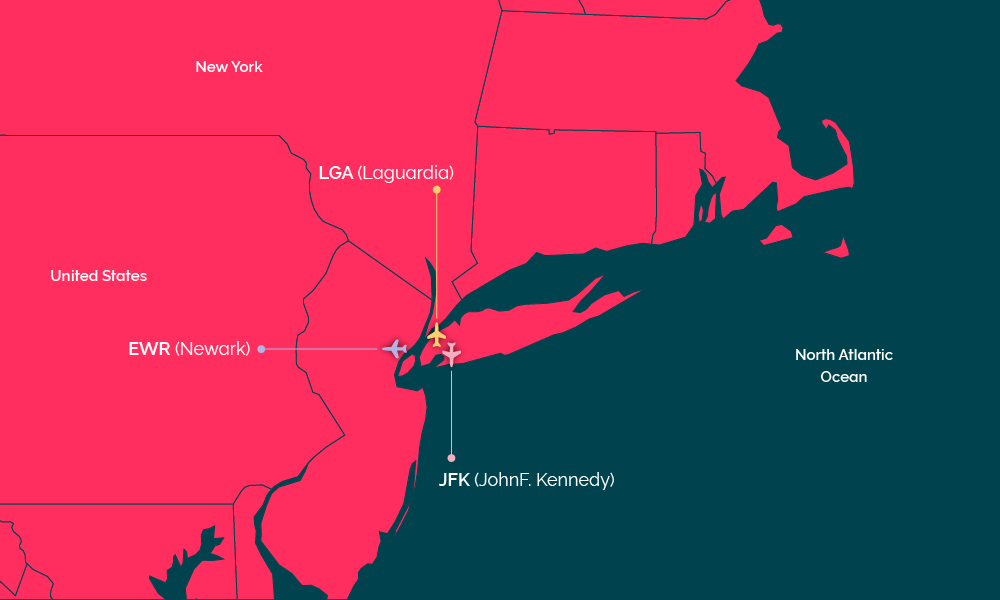
John F. Kennedy International Airport (JFK), in Queens, is the region's global gateway. If your trip crosses an ocean, this is home base. It's also mid-renovation on a $19 billion overhaul, so expect a construction zone with excellent duty-free.
LaGuardia Airport (LGA), also in Queens, is the scrappy local option, closest to Midtown at roughly 8.6 miles out. Thanks to the FAA's perimeter rule capping most nonstop flights at 1,500 miles, LGA sticks to what it's good at: quick, frequent East Coast shuttle runs.
Newark Liberty International Airport (EWR), across the Hudson in New Jersey, is United's East Coast command center and, frankly, the most reliable of the three when it comes to actually knowing when you'll arrive, thanks to a direct AirTrain and NJ Transit connection into Penn Station.
For business travelers based outside Manhattan, these same three airports are usually still the fastest way in and out. Teams coming from New Jersey business hubs like Newark, Jersey City, and Princeton often route straight through Newark Liberty since it's basically in the backyard. For business travel from Connecticut, particularly out of Fairfield County, Metro-North's New Haven Line runs directly into Grand Central, making it simple to connect through JFK or LaGuardia without fighting I-95 traffic.
Corporate Traveler's booking data for the region backs up each airport's personality. Between August 2025 and July 2026, JFK generated $33.9 million in travel spend across 22,750 transactions, with roughly 60% of that international. Newark wasn't far behind at $28.7 million and 31,220 transactions, about 52% international. LaGuardia posted the highest transaction count of the three at 32,523, but only 8.5% of that spend was international, proof that it's still doing exactly what it was built for: fast, frequent, domestic business travel.
Which airlines are hubbed at each airport?
Knowing who flies where helps you spot a direct flight instead of settling for a connection.:
- JFK is home to Delta's international operations and a major American Airlines presence, plus JetBlue's largest base in the country and a long list of global carriers including British Airways, Lufthansa, and Emirates.
- LaGuardia is Delta's domestic hub, with American Airlines running a close second, though neither flies long-haul international out of LGA.
- Newark belongs to United, one of its largest hubs nationally and the backbone of United's growing transatlantic schedule out of the region.
Stay in the loop.
The world of corporate travel is always changing. Sign up for newsletter and never miss a beat.
Should business travelers fly from JFK, LaGuardia, or Newark?
There's no single right answer here. It depends on where you're headed and how much time you're willing to spend on the ground. As a general rule of thumb:
Fly JFK when your itinerary is international or cross-country domestic. It has the broadest airline and route selection of the three, though its distance from Manhattan (about 15 miles) and its ongoing construction mean you should build in extra time.
Fly LaGuardia when you're traveling domestically and based in Midtown or Uptown Manhattan. It's the shortest drive on paper, but Grand Central Parkway at rush hour will happily turn a 20-minute ride into an hour, and there's no direct rail option waiting in the wings to bail you out.
Fly Newark when you want a dependable rail option or you're flying United. The NJ Transit and AirTrain combo gets you there from Penn Station in roughly 30 minutes, when it's running on schedule. Newark is a convenient option for business hubs across northern New Jersey.
None of these is the "right" airport in every situation, and that's the point. The best choice shifts depending on your destination, your timing, and what's happening that day at each airport, which is exactly why a travel management company and a dedicated Travel Manager earns their keep. When a flight cancels or a meeting gets moved up with two hours' notice, someone who already knows which airport has better same-day availability, shorter security lines, or a faster rebooking path saves you real time and money.
How can business travelers get between Tri-State airports and major business districts?
Landing is the easy part. Here's how to actually get where the meeting is, whether that's a Midtown high-rise or a New Jersey business park.

Getting between JFK and Manhattan
The AirTrain links every JFK terminal to the subway and the Long Island Rail Road at Jamaica Station, where you can also catch a train to Grand Central Madison or Penn Station. Budget 45 minutes to an hour by rail once you factor in walking and transfers, or plan for 40 minutes to an hour by car or rideshare, depending on how the Van Wyck Expressway is behaving that day, which is one of the more congested corridors in the region.

Getting between LaGuardia and Manhattan
LaGuardia skipped the subway memo entirely, so most travelers rely on taxis, rideshare, or the free LaGuardia Link Q70 bus to Jackson Heights or the Woodside LIRR stop. A direct car ride can take 20 minutes when traffic is good, and roughly triple that when it isn't. There's no in-between with LGA. It's either a breeze or it's not.

Getting between Newark Airport, Manhattan and New Jersey business hubs
Newark's AirTrain connects straight to NJ Transit and Amtrak at Newark Liberty Airport Station, putting Penn Station about 30 minutes away by rail, with onward service reaching New Jersey hubs like New Brunswick, Trenton, and Princeton along the Northeast Corridor. The drive into the city has also gotten a little friendlier since congestion pricing smoothed out the NJ Turnpike-to-tunnel approach. Headed to a New Jersey office park instead of Manhattan? A car or rideshare is still your fastest bet.
What should business travelers know when navigating JFK, LaGuardia and Newark?
Each airport has its own quirks worth knowing before you land.
-
Business travel through JFK
Build in extra buffer, full stop. Between the construction and JFK's job as the region's busiest international gateway, security lines and long gate walks can eat into a tight connection fast.
-
Business travel through LaGuardia
Confirm your terminal before you book ground transportation. LaGuardia's three terminals (A, B, and C) are spread out enough that a pickup at the wrong one turns into a real detour, and with no rail backup, road traffic is the one variable that decides your whole trip.
-
Business travel through Newark
Take the train when you can. It's the most predictable way to dodge road traffic, though NJ Transit delays are a real thing, so leave yourself a cushion if the meeting can't move without you.
Make Tri-State business travel easier to manage
None of this is complicated once someone else is tracking it for you, on a case-by-case basis. There's rarely one airport that's perfect for every scenario or every location. That's a program problem more than an airport problem, and it's exactly what a managed travel program is built to solve. Our Tri-State-based travel agents already know the best options for your business, so you don't have to figure it out alone.
Popular business travel routes from the Tri-State Area
We pulled a year of Corporate Traveler booking data to see where Tri-State business travelers are actually headed, and a few patterns jumped out fast.

What are the most popular domestic business travel routes?
San Francisco takes the top spot, with Los Angeles, Boston, Chicago, and Las Vegas rounding out the top five. That lineup lines up neatly with the region's finance, tech, and media concentration, industries that still run on face-to-face meetings on both coasts.

What are the most popular international business travel routes?
London isn't just the leader here, it's in a category by itself. Tokyo, Johannesburg, Cape Town, and Toronto fill out the rest of the top five, a mix that reflects the Tri-State Area's deep financial and consulting ties to the U.K. and a business travel connection to southern Africa that's easy to overlook if you're only planning for the obvious hubs.
What are the major business travel routes into the Tri-State Area?

The routes flowing into New York tell their own story. London Heathrow is the single busiest origin point into the region, responsible for roughly 23% of all inbound Tri-State business travel spend, more than triple the next closest market. Johannesburg holds that second spot, followed by San Francisco, Sydney, and Cape Town, with Los Angeles and Toronto close behind.
If your business regularly welcomes visitors, partners, or executives flying in from any of these markets, managing that inbound travel is just as important as booking your own team's trips out.
Which airlines fly the most business travelers through the Tri-State Area?
Who flies where matters beyond bragging rights. A hub airline usually means more nonstop options, better schedules, and a smoother connection if something goes wrong.

Delta is JFK's largest carrier by passenger volume and runs its primary transatlantic hub out of Terminal 4. JetBlue's biggest base anywhere is also at JFK, out of Terminal 5, and American operates its New York hub from Terminal 8. LaGuardia is Delta's domestic hub, with American, United, JetBlue, and Southwest all flying out of the airport's newer Terminal B. Newark is United's hub, and one of its largest for transatlantic service, which is why it's the most United-heavy of the three airports for business travel (per public airline and airport reporting).
Corporate Traveler's booking data for the region confirms this. United and Delta dominate outbound travel from the Tri-State Area, together accounting for more than 60% of total spend, with the remainder spread across dozens of carriers including American, JetBlue, Air Canada, and British Airways. Inbound to New York, United still leads, but British Airways jumps to the number two spot, a reminder of how much of the region's air traffic runs through that London corridor in both directions.
If your team flies a specific carrier often, booking through that airline's home airport is usually the fastest route to a direct flight instead of a connection.
How can businesses manage frequently traveled routes more effectively?
If your team flies the same handful of routes over and over (say, New York to San Francisco every other week), you have leverage and data you're probably not using. A few ways to put it to work:

- Negotiate corporate airfares on your highest-volume routes instead of booking each trip fresh.
- Set a routing policy that defaults to the airport with the best combination of cost, time, and reliability for that specific route, not just whichever one is closest.
- Track spend and on-time performance by route so you can catch reliability problems before they turn into a real budget issue, one worth checking against common budget leaks.
- Keep an eye on Corporate Traveler's resource hub, which tracks fare trends and policy shifts year-round, so you know when a negotiated route rate is due for a refresh.
- Build in standard ground transportation booking so no one's improvising a ride from LaGuardia at 11 p.m.
None of this requires a spreadsheet marathon. It requires visibility into your own data, which is where most in-house travel management starts to break down.
How can Corporate Traveler help manage business travel to and from the Tri-State Area?
This is our home turf, literally. Corporate Traveler is headquartered right here in the Tri-State Area, which means we're not guessing which airport makes sense for your 8 a.m. meeting in Midtown. As a New York business ourselves, we know firsthand which flights get you to your destination seamlessly.
We book and manage travel across JFK, LaGuardia, and Newark every single day, and we use this same route-level data to help clients choose smarter defaults, negotiate better rates on their most frequent trips, and skip the guesswork that turns a routine trip into a whole afternoon of rebooking.

That guesswork is where a Travel Manager pays for themselves fastest. There's no single airport that's always the right call, and knowing when to steer a traveler toward JFK instead of Newark, or catch that LaGuardia has a same-day option when a flight out of JFK just canceled, is exactly the kind of decision that saves a company real money on last-minute bookings and disruptions, not just on the trips that go according to plan.
Whether you're a five-person team booking your first New York trip or a growing NY company managing dozens of Tri-State routes a month, we build the travel policy and platform that fits how your business moves.
Ready to simplify your business travel?
Three airports, dozens of routes, and one team that already knows how to navigate all of it. Corporate Traveler helps businesses across the Tri-State Area book smarter, move faster, and stop losing time second-guessing which airport to book. Let's build a travel program that actually fits how your team flies.

FAQs
-
How much time should business travelers allow between Manhattan and a New York airport?
Plan for 45 to 60 minutes to JFK, 30 to 45 minutes to LaGuardia in normal traffic (longer during rush hour), and about 30 minutes to Newark by rail or 45 to 60 minutes by car. Add extra time during peak commute hours or major holiday travel periods, when the Port Authority has recorded some of its busiest passenger volumes on record.
-
Is JFK, LaGuardia or Newark best for a Manhattan business trip?
For most Manhattan-based business trips, LaGuardia offers the shortest distance if you're traveling domestically, while JFK is the better choice for international itineraries. Newark is a strong option when a reliable rail connection matters more than proximity, particularly if traffic or weather is a concern.
-
Should business travelers pre-book airport transportation in New York?
Yes. Pre-booking a car service or confirming your rail route in advance removes one more variable from a trip, especially at LaGuardia, where there's no rail backup if road traffic runs long.
-
What is the best way to travel between meetings in New York and New Jersey?
For trips between Manhattan and New Jersey business hubs, NJ Transit and Amtrak both run frequent service through Penn Station, and a car or rideshare works well for door-to-door trips outside the main rail corridors. The right choice depends on your exact origin and destination, which is where a managed travel program earns its keep.
Related resources


