

How to reduce airfare costs: 7 proven strategies for business travel
Published: Jul 13th, 2026
Key takeaways:
Airfare is typically the single biggest cost on a business trip, and one of the most controllable. Seven proven strategies help companies reduce airfare costs without reducing trips: booking earlier, setting a clear travel policy, matching fare class to the trip, using negotiated corporate fares, adopting the right booking tools, controlling ancillary fees, and partnering with a travel management company. Global business travel spend is forecast to hit $1.69 trillion in 2026 (GBTA), and businesses that manage travel well can save up to 25% on total costs. The goal is smarter spend, not less of it.
Forty-seven browser tabs. Three airline apps. One "great deal" that somehow costs more than the original fare. Sound familiar?
Airfare is typically the single biggest line item on a business trip, often close to half the total cost. And hunting for cheaper flights eats up more time than it should — especially when a "great deal" on a Basic Economy ticket quietly turns into a budget nightmare once fees, change restrictions, and the occasional rebooking disaster stack up. So when budgets tighten, it makes sense that flights are the first thing finance leaders look at. What's less obvious is that you don't have to cut trips to cut costs.
This guide breaks down seven proven ways to reduce business travel costs for small- and medium-sized businesses, from booking earlier to accessing negotiated corporate fares through a TMC (travel management company). Each strategy is straightforward, measurable, and designed to protect traveler experience while trimming spend. Whether you book travel yourself or oversee a growing travel program, you'll find practical steps to apply this quarter, plus the metrics to prove the savings to your leadership team.
Why airfare costs (really) matter
Reducing airfare costs means lowering what your company pays per flight without lowering the number or quality of trips. Think of it less as cutting spend and more as cutting waste.
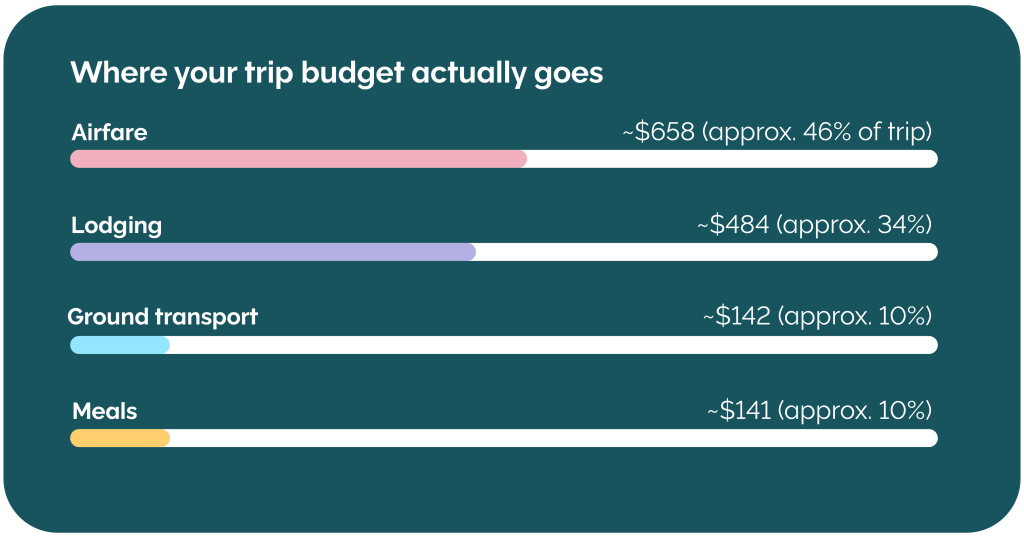
The difference between the published fare (what anyone can see online) and the effective fare a well-managed program actually pays, after negotiated rates, smart booking windows, and avoided fees, can be considerable. And because airfare typically dominates a business trip's total cost, small percentage gains compound quickly across an entire year of travel.
The macroeconomic backdrop makes this more urgent, not less. GBTA forecasts global business travel spending to reach $1.69 trillion in 2026, an 8.1% year-over-year increase. The global average ticket price is expected to reach approximately $708 in 2026, a 0.4% uptick year on year, per the CWT/GBTA Global Business Travel Forecast. And the average managed North American business trip costs around $1,425, with airfare accounting for roughly $658, about 46% of the total, according to Emburse Certify Travel Trends data.
For finance leaders, airfare volatility directly affects forecasting accuracy and margin. For HR and operations leaders, travel cost ties to employee experience and retention. For travel managers and executive assistants, it's a daily balancing act between price, policy, and what travelers need, and every hour spent hunting for a better fare is an hour that isn't going toward something more valuable.
The SME angle is particularly telling. Smaller programs often lack negotiated rates and rely on last-minute, out-of-policy bookings, which is exactly where overspend quietly piles up. The good news: the savings methods available to SMEs are real, and none of them require sacrificing duty of care or traveler comfort.
The key drivers of airfare cost are:
- Booking lead time: How far in advance the ticket is purchased
- Fare class: Basic vs. Standard vs. Flexible Economy, and cabin
- Negotiated rates: Corporate agreements vs. published fares
- Policy compliance: In-policy bookings vs. out-of-policy "leakage"
- Ancillary fees: Bags, seats, and change fees that inflate "cheap" tickets
Understanding where your program sits on each of these is the starting point. The seven strategies below are your action plan.
How can companies reduce airfare costs?
Companies reduce airfare costs by combining smart timing, clear policy, and buying power. These seven methods work best together: policy plus a booking tool plus negotiated fares compound savings in a way that no single move can on its own. And all of them are achievable for SMEs, not just the travel programs of Fortune 500 companies.
1. Book earlier to lock in lower fares
The single most predictable driver of airfare overspend is booking late. Airlines use dynamic pricing that adjusts in real time based on demand and remaining seats, and prices climb steeply in the two weeks before departure. Why? Because airlines know last-minute travelers are less price-sensitive. They've got a meeting to get to. They'll pay.
Don't be that person. According to Corporate Traveler's 2025 data, minimal lead time cost our US clients $818,000 in missed savings, one of the top five reasons for preventable spend. Set a minimum advance-booking window in your travel policy and track lead time monthly.
2. Put a clear travel policy in place
A travel policy sounds less exciting than it is. Bear with us.
Without one, employees book on personal preference, airline loyalty, habit, or pure proximity to deadline, and that's precisely where "cheap" flights quietly get expensive. A good policy sets advance-booking rules, preferred airlines, cabin caps, and expectations around ancillary fees. It removes guesswork, standardizes behavior, and protects the negotiated rates you've worked hard to secure.
Crucially, it also sets clear expectations for travelers upfront, which tends to reduce friction rather than cause it. Nobody likes being surprised by a rejection at the point of booking. Nearly a quarter of business travelers (22%) overspend on travel simply because they wait too long to book, and most of that is entirely fixable with clear guardrails in a policy document.
For most SMEs, a concise, well-communicated travel policy is the highest-impact first step, and the quickest to implement.
3. Match the fare class to the trip
Basic Economy looks cheap, right up until it isn't. Factor in the baggage fee, the seat selection charge, and the change restriction on a trip that ends up shifting, and that bargain fare has often cost more than a Standard Economy ticket would have. The rule: match fare class to trip certainty. Nobody wants to explain to the CFO why a $189 fare ended up costing $650 after a last-minute change. Our guide to economy classes for business travel breaks this down in full.
4. Use negotiated corporate fares
Volume-based airline agreements give your company discounted rates and perks the general public simply can't access. The catch? Most SMEs don't have enough travel volume to negotiate these independently. That's where a TMC comes in. Corporate Traveler is part of Flight Centre Travel Group, one of the world's largest travel agencies, which means the buying power we bring to airline negotiations goes well beyond what any individual SME could achieve alone.
5. Adopt a booking tool and spend analytics
Something a Google Flights tab cannot do: enforce your travel policy at the point of booking. An online booking tool (OBT) surfaces the lowest in-policy fares and flags out-of-policy choices in real time. Spend analytics close the loop, revealing exactly where your program is leaking and giving you the evidence to renegotiate rates where it matters. SMEs using Corporate Traveler's Melon platform are saving up to 18% per trip.
6. Control ancillary and change fees
Ancillary fees are the quiet budget-killer, the kind that don't show up in the headline fare but absolutely show up in the expense report. Bags, seat selection, priority boarding, and last-minute change fees can add 20% to 40% to a fare that looked like a bargain at the time of booking. Multiply that across a year's worth of trips and you've got a meaningful line item that nobody explicitly approved.
Require bookers to compare total trip cost rather than headline fare, build ancillary expectations into your policy framework, and favor flexible fares for any trip with a realistic chance of a schedule change. Paying once for flexibility beats paying twice for an emergency rebook at gate prices.
7. Partner with a TMC for price assurance
A TMC is the multiplier for everything above. A good TMC negotiates rates, enforces policy at the booking stage, monitors fares after purchase, and can rebook flights automatically when prices drop, capturing savings you'd have missed entirely.
The fee is typically more than offset by what you save, plus the staff hours your travel bookers no longer spend hunting across the open web. For SMEs, Corporate Traveler's dedicated travel managers and Melon booking platform are built specifically to deliver these results without enterprise-level complexity.
Our Client Savings and Value Team monitors booked fares, tracks expiring credits, and finds upgrade opportunities on an ongoing basis. In 2025, that team saved our US customers over $1.4 million.
What are the benefits of reducing airfare costs?
Reducing airfare costs lowers total travel spend, improves budget predictability, and frees money for the trips that matter most.
But the benefits go well beyond a smaller invoice. Done right, savings come without cutting trips, so teams keep meeting clients, closing deals, and doing the things that justify the flights in the first place. Here's how those benefits land for different people in your organization:

- Lower total travel spend: Fewer dollars per ticket, multiplied across every trip all year
- Predictable budgets: Negotiated rates and policy reduce surprise costs (finance leaders, this one's for you)
- Reclaimed staff hours: Less time spent searching fares, managing disruptions, and chasing exceptions (a very real win for travel managers and executive assistants)
- Stronger policy compliance: More in-policy bookings, less leakage from out-of-system spend
- Better data: Clear visibility into where spend goes and what to renegotiate next cycle
- Maintained traveler experience: Savings without forcing uncomfortable, inconvenient, or time-wasting itineraries on the people making the trips
- Improved duty of care: Managed booking tracks travelers and supports them when things go sideways
That last point deserves more credit than it usually gets. A managed program isn't just cheaper, it's more resilient. When a flight is cancelled at midnight in Denver, having a TMC with 24/7 support in your corner is a very different experience from refreshing a consumer app alone and hoping for the best. See how Corporate Traveler's managed travel program delivers these benefits in practice.
How much can businesses actually save on airfare?
That depends on where you're starting from. An unmanaged SME has considerably more upside than a program that's already running tightly. But the numbers are meaningful either way.

Here's how the strategies stack:
| Strategy | How it works | Typical savings |
| Book earlier | Locks in fares before they spike near departure | ~10% per year |
| Right fare class | Avoids fees and costly last-minute changes | Reduces "cheap-fare" surprise charges or fees |
| Negotiated corporate fares | Discounts below published fares via volume agreements | Varies; stacks with timing |
| Policy compliance | Cuts out-of-policy leakage | Protects budgeted spend/savings |
| Full TMC management | Rates + price assurance + time saved | Up to ~25% on travel costs |
For context on what a well-run program really delivers: Corporate Traveler clients saved over $21 million and reclaimed more than 37,000 hours in 2025. Our clients returned $1.51 for every $1 spent on management fees.
One concrete example:
One of Corporate Traveler’s clients, a refrigerants company, shifted its average domestic booking lead time from 15 to 30 days and saw roughly 10% savings on airfare per year, all from a single behavioral change. No new tools. No renegotiated contracts. Just booking earlier. Use our business travel savings calculator to see what your program could be saving.
When is the best time to book business flights?
The best time to book business flights is as early as the trip is confirmed. Which, to be clear, is not the night before.
For domestic US and Canada routes, aim for at least two to three weeks in advance, ideally more. For international, four to six weeks is a solid baseline, with peak-season travel warranting even earlier action. Airlines adjust fares constantly based on demand and remaining seats, so waiting almost always costs more. Prices tend to spike sharply within the 14 days leading up to departure, and the industry data on this is pretty unambiguous.
| Trip type | Recommended advance booking | Why |
| Domestic (US/Canada) | 14 to 21+ days | Avoids late-booking fare spikes |
| International | 4 to 6+ weeks | Wider fare range; more seat options |
| Peak/event periods | Even earlier | Limited inventory, faster price climbs |
The simplest fix is a written advance-booking rule in your travel policy. Track lead time monthly and you'll have a direct line of sight to one of the most controllable cost drivers in your entire program.
What is the difference between Basic, Standard, and Flexible Economy?
Basic Economy is the lowest published fare. It is also, with alarming regularity, not the cheapest option once you actually price the full trip.
| Feature | Basic Economy | Standard Economy | Flexible Economy |
| Headline price | Lowest | Mid | Highest |
| Seat selection | Fee | Included | Included |
| Checked bag | Fee | Often 1 free | Included |
| Changes | Restricted/fee | Higher change fee | Allowed |
| Refundable | Usually no | Sometimes | Often yes |
| Best for | Fixed, simple trips | Most business trips | Trips likely to change |
The rule of thumb: match fare class to trip certainty. Fixed, predictable itineraries can often use a Basic or Standard fare without drama. Anything where the schedule might shift, whether that's senior leaders, multi-city routes, or trips tied to live negotiations, generally justifies a Flexible Economy fare when the total cost is calculated honestly.
Nobody wants to explain to the CFO why a $189 fare ended up costing $650 after a last-minute change. For a full breakdown, our guide to economy classes for business travel covers every scenario.
How do negotiated corporate fares work?
Negotiated corporate fares are discounted prices airlines offer companies in exchange for consistent booking volume or loyalty. Think of them as the airline's way of saying "we'd like your business, and we're willing to make it worth your while."
They sit below public fares and often include extras like waived fees, priority boarding, seat upgrades, or status matches for frequent travelers. Most SMEs access them through a TMC, which pools demand across many clients to unlock rates that no individual business could secure on its own. Our guide to corporate travel discounts explains how to get them.

How to unlock negotiated fares:
- Consolidate spend with a small set of preferred airlines — volume is leverage
- Track spend by route to support future negotiations with real data
- Use a TMC to access pooled, pre-negotiated rates without needing enterprise-level volume
- Add price assurance so fare drops after booking are automatically recaptured
- Review annually — as your program grows, your rates should too
Corporate Traveler is part of Flight Centre Travel Group, one of the world's largest travel agencies. That scale translates directly into buying power that works for our clients, including SMEs who'd have no shot at these rates going it alone.
Which tools help lower airfare costs?
The most impactful combination is an online booking tool, spend analytics, and integrated expense management, all working together rather than as three separate headaches.
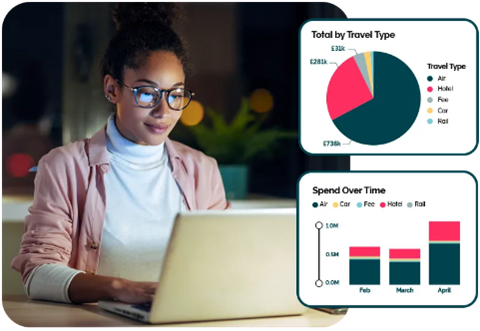
- Online booking tool (OBT): Surfaces the lowest in-policy fares, enforces your travel policy at the point of booking, and stores negotiated rates so they're applied automatically every time
- Spend analytics dashboard: Reveals exactly where your program is leaking and which routes to renegotiate
- Expense management integration: Removes manual reconciliation and closes the gap between booking and finance reporting
- NDC-enabled content: New Distribution Capability connects directly to airline inventory, surfacing richer fare options and bundled ancillaries that older booking systems can miss entirely
- Duty-of-care and traveler tracking: Safety and visibility in one place, rather than bolted on as an afterthought
When booking, policy enforcement, and reporting all live in one place, finance teams can see exactly where spend is going, and travel managers can stop playing detective across five different platforms at 4pm on a Friday. See how Corporate Traveler's travel program tools work together to deliver these results.
How do you measure airfare savings?
With a small, consistent set of metrics tracked monthly against a real baseline. Nothing fancy, just the numbers that tell you whether the program is working.
| Metric | What it measures | Why it matters |
| Cost per trip | Average total cost per trip | Top-line budget health |
| Average ticket price (ATP) | Average airfare paid | Core airfare benchmark |
| Booking lead time | Days between booking and departure | Predicts fare savings |
| Policy compliance rate | % of in-policy bookings | Protects negotiated savings |
| ROI on management fees | $ saved per $1 spent | Proves program value |
Use 2025 actuals as your baseline and track month over month. Then, and this part matters, share results with senior leadership. Savings that aren't measured don't get credited, and programs that can't show ROI tend to get cut instead of grown.
Ready to stop leaving money at the gate?
Corporate Traveler works with growing businesses across the US to build smarter travel programs, from negotiated corporate fares to real-time spend analytics and 24/7 expert support. Our clients returned $1.51 for every $1 spent on travel management fees in 2025. Talk to a travel expert today and find out what your program could be saving.

FAQs
-
Does a travel policy actually reduce airfare costs?
Yes, and it's usually the fastest win available to an SME. A clear travel policy standardizes how employees book, so fewer trips get booked late or outside the approved options. It sets advance-booking rules, preferred airlines, and cabin caps, turning a series of ad hoc decisions into a consistent, measurable system. Policy is the foundation that makes every other savings strategy enforceable. Without it, you're negotiating great rates that nobody is actually using.
-
Are budget airlines and cheap flights better for business travel?
Not always, and often not once you add everything up. A low discount fare can cost considerably more once baggage fees, seat selection, and change penalties are included, and when things go wrong on a low-cost carrier, getting help quickly is a different experience than it would be through a managed program. Compare the total cost of the ticket, including ancillary fees and the real value of flexibility. For business travel, reliability and flexibility tend to outweigh the lowest sticker price.
-
What does it mean to reduce airfare prices for a business?
It means paying less per flight without flying less. Reducing airfare costs is about cost efficiency, not cost cutting, lowering the effective price per ticket through smarter booking habits, a clear travel policy, negotiated corporate fares, and the right tools. The goal is for travelers to still get where they need to go, on time and comfortable, while the company spends meaningfully less to make that happen.
-
How do airline loyalty programs save money?
Travel rewards can also offset airfare when a business uses airline loyalty programs and redeems through partner airlines strategically. The right credit card may also offer sign-up bonuses of 60,000 to 100,000 points, and accumulated points are often especially valuable on long-haul flights.
-
Can you get money back if a fare drops after booking?
Often, yes, through price assurance. Some travel management programs actively monitor booked fares and automatically rebook at a lower price when fares fall, and travelers can also use fare alerts or flight alerts to track booked itineraries and catch a lower fare when prices drop, capturing the difference on your behalf. This is the kind of thing that happens in the background while you're doing other things. Before choosing a program, confirm whether fare monitoring and automatic rebooking are included, since not every provider offers it.
-
How far in advance should employees book to save the most?
As early as the trip is confirmed. For domestic flights within the US and Canada, aim for at least two to three weeks out; for international flights, four to six weeks or more. For international trips, especially on long haul itineraries or volatile international routes, booking earlier matters more. Airlines constantly adjust fares based on air travel demand and available seats, and the pattern is clear: the closer you get to departure, the more you pay. A written advance-booking rule in your travel policy is the simplest, most reliable way to capture lower fares consistently across your whole team.
-
Is a travel management company worth the fee for a small business?
Usually, yes, often by a considerable margin. A TMC brings negotiated rates, policy enforcement, price assurance, reclaimed staff time, and 24/7 support when things go wrong, all benefits that are genuinely difficult for a small team to replicate independently. Corporate Traveler clients in the US returned $1.51 per $1 spent on management fees in 2025. Use our savings calculator to see what the numbers look like for your program specifically.
-
What is NDC and why does it matter for airfare costs?
NDC, or New Distribution Capability, is an airline standard for sharing richer fare and ancillary content directly with booking platforms. For corporate buyers, the practical upshot is clearer pricing, bundled options, and access to fares that older booking systems can't see. NDC-enabled booking can surface genuinely better-value tickets and makes the true total cost of a trip much easier to compare at the point of booking, which is exactly where good decisions get made.
-
What is the biggest reason businesses overspend on airfare?
Booking too late, consistently. Nearly a quarter of business travelers (22%) overspend on travel simply because they wait too long to book, and it's one of the most preventable causes of airfare waste. After that, out-of-policy bookings, untracked ancillary fees, and mismatched fare classes are the next biggest culprits. All of them are solvable with a clear travel policy and the right booking tools. The problem is rarely a lack of options; it's a lack of structure around how those options get used.
Related resources


