

How to select a TMC: Here's your criteria, checklist, and RFP template
Published: July 20th, 2026
Key takeaways:
- Select a TMC using a structured process: RFI to shortlist, RFP to compare, weighted scorecard to decide.
- Weigh technology, service, and fee transparency together. The cheapest fee isn't the best deal if support and duty of care fall short.
- A good TMC centralizes bookings, enforces policy automatically, and gives finance one clean view of spend.
- Score every provider on the same scale before demos, so the final decision holds up to leadership, not just gut feel.
Choosing a travel management company (TMC) is one of those decisions that looks small on an org chart and huge on a P&L. Get it right and you cut travel costs, keep your people safe on the road, and give finance, HR, and operations one clean source of truth for spend. Get it wrong and you're stuck with hidden fees, a booking tool nobody opens twice, and duty-of-care gaps that quietly get riskier the longer you ignore them.
Business travel is a top-three controllable cost for most organizations, and global spend keeps climbing. Global business travel spending is on track to hit a record $1.57 trillion in 2025, with an 8.1% rebound projected for 2026 and a march past $2 trillion by 2029, according to the Global Business Travel Association. That kind of growth makes a structured TMC selection process essential, not a nice-to-have.
This guide walks you through exactly how to select a TMC: what a travel management company does, the selection criteria that predict success, a step-by-step process, the questions worth asking, and a ready-to-copy RFP template you can adapt today. Whether you're ditching in-house booking, switching providers, or buying for the first time, you'll come out the other side with a clear, defensible way to choose the TMC that actually fits how your company travels.
What is a travel management company (TMC)?
A TMC is a specialist agency that books and manages business travel for organizations, handling everything from flights to duty of care.
A travel management company is more than a booking agent with a nice logo. It pairs expert human support with proper travel technology to run a complete managed travel program, not just a string of individual bookings. Compare that to a consumer booking site: a TMC layers on policy controls at the point of sale, negotiated corporate rates, traveler tracking, consolidated reporting, and an actual team who picks up the phone when a flight gets canceled at 3am.
Under the hood, most TMCs run on an online booking tool (OBT) connected to global distribution systems (GDS) and increasingly New Distribution Capability (NDC) content, which is a fancy way of saying they can access more fares and ancillaries than a traveler booking solo ever could. Combine that tech with a genuine duty-of-care process, as well as Travel Mangers who’ve solved these issues before, and you've got a managed travel program — not just a travel agent on speed dial.
Here's what a good TMC does for you:
- Books and manages flights, hotels, rail, and ground transport
- Builds and enforces your travel policy at the point of booking
- Provides 24/7 traveler support during disruptions
- Tracks travelers for duty of care and safety
- Consolidates travel data into one reporting dashboard
- Negotiates corporate rates and reclaims unused tickets
- Integrates booking with your expense and finance systems
- Continuously optimizes your travel program over time
Why does choosing the right TMC matter?
It matters because travel is a top-three controllable cost and a genuine duty-of-care obligation, so getting it wrong is expensive twice over.
Every stakeholder in your business has a different reason to care. Finance wants visibility and savings they can show the board. HR and operations want a real safety net for travelers, not a PDF policy nobody reads. Logistics leaders want ground transport and itineraries that stay coordinated even when a trip changes at the last minute. Executive assistants and travel bookers want their evenings back. And the C-suite just wants to see how to maximize ROI from corporate travel management, in numbers they can take straight to the board.
Here's what's at stake for each part of the business:
| Stakeholder | Top priority | Risk of the wrong TMC | What the right TMC delivers |
|---|---|---|---|
| Finance/C-suite | Cost control and ROI | Hidden fees, opaque pricing | Transparent fees, measurable savings |
| HR/Operations | Traveler safety | Duty-of-care gaps | 24/7 support, tracking, alerts |
| Travel Managers | Visibility and control | Fragmented data | Single reporting dashboard |
| Logistics leaders | Smooth coordination across trips and transport | Disconnected bookings, no visibility into logistics | Coordinated ground transport, real-time itinerary tracking |
| Executive Assistants/Bookers | Time savings | Slow, manual booking | Fast self-service plus expert backup |
The backdrop makes this more urgent, not less. Global business travel spending hit a record high in 2025 and is forecast to keep climbing through the decade, per GBTA. At the same time, industry consolidation among providers has pushed plenty of mid-market buyers to re-evaluate their current setup, which is a big part of why RFP activity has picked up lately. Layer in "booking leakage", which is the sneaky term for staff booking outside your negotiated channels and policy, and a poor TMC fit starts costing you savings you never even knew you had.
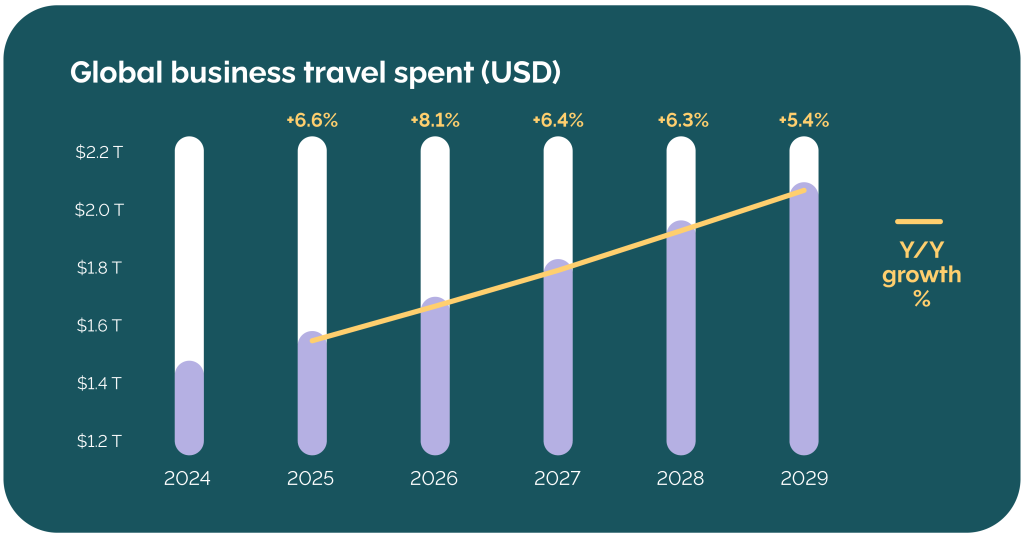
Global business travel spending is on track to pass $2 trillion by 2029. Source: 2025 GBTA Business Travel Index Outlook Report.
When does a business need a TMC?
A business needs a TMC once travel volume, complexity, or risk has outgrown ad hoc booking.
There's no single magic number, though $100K in annual travel spend is a common tipping point for bringing in a TMC. What matters more is whether travel has quietly become someone's second job, or whether the risk exposure has crept past what a spreadsheet can manage. Common trigger signals include:
- Someone is booking travel as a side job, not their actual role
- Travel spend is rising but nobody can see where it's really going
- Trips are getting more frequent, more international, or more complex
- Late-night travel emergencies have become your personal problem to solve
- You have no clear traveler-tracking or safety process
- Finance is struggling to reconcile travel expenses every month
If you nodded along to more than two of those, congratulations: you're now an unlicensed travel agent, on top of your actual job. You're also probably past the point where DIY booking makes sense, even if your business still feels too small for a TMC. That's an assumption that rarely holds up once you add up the hours and rebooking fees DIY travel is quietly costing growing SMEs.
What should you look for in a TMC?
Look for a TMC that fits your company’s size, travel patterns, and culture, weighing technology and service together rather than chasing the lowest fee.
There's no single "best" TMC on the market, so read the fine print before you swipe right on the first one with a slick pitch deck. There's only the best fit for how your company travels, and that's the mindset to bring into every conversation with a provider. This is the anchor list of TMC selection criteria, so bookmark it. Service quality is what your travelers feel every single day, and it deserves top billing here, even though technology is what most industry surveys rank first. The two still need to be weighed side by side, since a beautiful booking tool means nothing if nobody answers the phone at 2am.
A quick translation, because TMC pitches love acronyms:
- The OBT is the online booking tool your staff use
- The GDS is the global distribution system that aggregates airline, hotel, and rail content
- NDC is the newer standard that unlocks richer fares and ancillaries beyond classic GDS content
None of that matters if fee transparency isn't there too, since itemized, no-surprises pricing is what separates a genuine strategic partner from a low-cost transactional vendor.
Here's what to look for in a TMC: a criteria table to run every shortlisted provider through.
| Criterion | What to check | Why it matters |
|---|---|---|
| Technology and booking tool | OBT usability, mobile app, GDS/NDC content, OBT adoption rates | Drives adoption, savings, and self-service speed |
Service and support model
| 24/7 support, dedicated account manager, named service team | Determines real-world traveler experience
|
| Fee transparency | Itemized fees, add-ons, no hidden charges | Protects budgeted spend/savings |
| Industry experience | Track record with companies your size and sector | Predicts fit and reduces ramp-up risk |
| Risk and duty of care | Traveler tracking, alerts, emergency assistance | Meets legal and safety obligations |
| Reporting and data | Dashboards, data ownership, KPIs | Enables visibility and continuous savings |
| Sustainability | Carbon reporting, SAF options, ESG support | Supports ESG goals and reporting |
| Integration | HR, finance, and expense system connections | Reduces manual work and errors |
Company size changes what "good" looks like here too, and so does geography: whether you need a local versus global TMC footprint matters as much as any line item on this checklist. An enterprise with a dedicated procurement team can absorb a slower, heavier onboarding process. A growing SME usually can't, and shouldn't have to. This is genuinely where Corporate Traveler earns its keep: we're built around the niche needs of growing businesses, not bolted onto an enterprise model as an afterthought. If you want to weigh these criteria against each other, jump ahead to the weighted scorecard section below.
How do you select a TMC, step by step?
Define your needs, gather stakeholders, shortlist with an RFI, run a structured RFP, score with a weighted scorecard, then demo, check references, and negotiate.
Unfortunately, going with your gut feeling is a terrible procurement strategy. A disciplined process beats it every time, and the single most common failure mode in TMC selection is a weak evaluation method, not a weak market of providers. Here's the sequence that works:
- Define your needs and goals. Audit current travel spend, pain points, and policy gaps. Decide what success looks like in 12 months across cost, safety, and traveler experience.
- Gather your stakeholders. Bring in finance, HR, operations, and frequent travelers, plus an executive sponsor. Align on priorities before you talk to a single provider.
- Shortlist with an RFI. Issue a short Request for Information to filter the market down to three to five providers that meet your minimum criteria.
- Issue a structured RFP. Send a tailored Request for Proposal with your company profile, travel data, and weighted questions. Share your scorecard criteria upfront so bidders respond to what really matters to you.
- Score responses with a weighted scorecard. Rate each provider against your criteria before demos, so the process stays objective and comparable across bidders.
- Run demos and check references. Test the booking tool live, not in a slide deck, and call references the TMC didn't hand-pick, including a recent former client for the unfiltered version.
- Negotiate and plan implementation. Confirm fees, SLAs, and data ownership in writing, then agree on an onboarding timeline, training, and go-live support before you sign anything, since how you implement a new TMC often decides whether year one actually delivers the savings you modeled.
What questions should you ask a TMC?
Ask about technology adoption, support structure, full fee breakdowns, data ownership, and how they've handled a real disruption.
The goal of every question below is the same: confirm that what you see in the sales pitch is really what your account will receive after the ink dries, since a slide deck has never once rebooked a flight at midnight.
- What are your OBT adoption rates for clients our size and travel mix, and what negotiated rates and service standards come as standard?
- How is 24/7 support staffed, and what are your response-time SLAs? (For reference, Corporate Traveler runs 24/7 service with an emergency line staffed around the clock, calls picked up within five rings, and requests actioned within four hours.)
- Can you provide a full, itemized breakdown of fees and add-ons?
- Who owns our travel data, and how is it secured against standards like PCI DSS and GDPR?
- Who is on our named account and service team day to day? (With Corporate Traveler, you'll always have a dedicated Travel Manager and team assigned to your account, not a rotating call center.)
- What does your implementation timeline and training look like?
- How do you measure and report traveler satisfaction?
- Can you share a recent example of managing a major disruption?
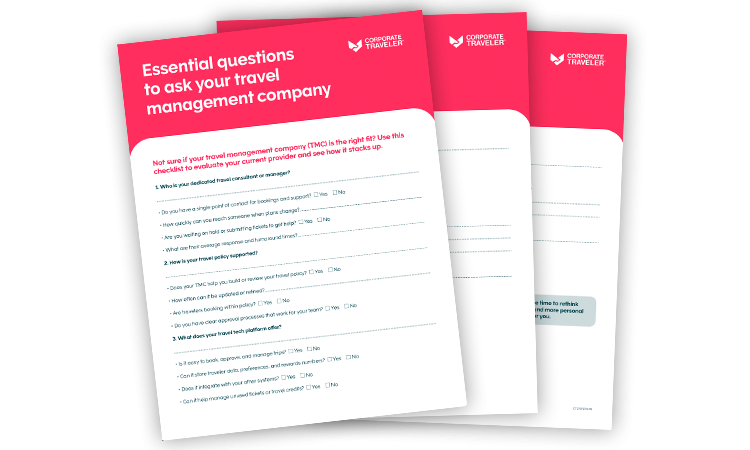
Get the checklist
Run this exact list past every provider on your shortlist using our TMC evaluation checklist, a ready-to-use question bank that turns answers into a genuine side-by-side comparison instead of a folder of mismatched PDFs.
What should you include in a TMC RFP?
A TMC RFP should cover your company profile, travel data, service expectations, technology requirements, pricing, risk needs, sustainability goals, and a scoring matrix.
Quick terminology check before you draft anything: an RFI (Request for Information) is for shortlisting, an RFP (Request for Proposal) is the full document for comparing providers, and an RFQ (Request for Quotation) is narrowly about pricing. Most TMC selections use an RFI to shortlist, then a proper RFP to decide.
Resist the temptation to recycle a generic 30-page procurement template, the kind that makes bidders' eyes glaze over by page three. Tailor your questions to your actual program, and share the same baseline travel data with every bidder so the comparison stays fair, one of the simplest travel management procurement strategies for SMEs looking to punch above their weight at the negotiating table.
Here's what a solid TMC RFP template should include:
| RFP section | What to include | Purpose |
|---|---|---|
| Company profile | Size, locations, travel culture, goals | Gives context for tailored proposals |
| Travel data | Annual spend, volumes, top routes, booking mix | Enables accurate, comparable pricing |
| Service requirements | Support hours, account model, SLAs | Sets service expectations |
| Technology | OBT, mobile, integrations, reporting | Tests the tech stack fit |
| Pricing | Fee model, add-ons, contract terms | Reveals true total cost |
| Risk and duty of care | Tracking, alerts, emergency process | Confirms safety capability |
| Sustainability | Carbon reporting, SAF, ESG support | Aligns with ESG goals |
| Scoring matrix | Weighted criteria and ratings | Keeps evaluation objective |
If you want this TMC RFP template laid out as a ready-to-copy document structure, use this order:
- Introduction and objectives
- Company and travel program profile
- Scope of services required
- Technology and integration requirements
- Service, support, and account management
- Pricing and commercial terms
- Risk management and duty of care
- Sustainability and reporting
- Implementation and transition plan
- Evaluation criteria and weighted scorecard
How do you compare TMCs and score them?
Compare TMCs with a weighted scorecard built before any proposals arrive, rating every provider on the same scale.
Build your weights before you read a single response. That order matters: it stops a slick pitch on one feature (looking at you, flashy app demos) from masking weak fit everywhere else, and it keeps the final decision defensible when you present it to leadership, whether you're comparing shortlisted providers or still weighing unmanaged versus managed business travel in the first place.
| Criterion | Weight | Provider A (1 to 5) | Provider B (1 to 5) | Weighted notes |
|---|---|---|---|---|
| Technology and OBT | 25% | Adoption, usability, integrations | ||
| Service and support | 25% | 24/7, account team, SLAs | ||
| Fee transparency | 20% | Total cost, no hidden fees | ||
| Risk and duty of care | 15% | Tracking, emergency response | ||
| Reporting and data | 10% | Dashboards, data ownership | ||
| Sustainability | 5% | Carbon reporting, SAF |
How much does a TMC cost?
TMC costs vary by service level, travel volume, and pricing model, so focus on total value rather than the headline fee.
Three fee models cover most of the market:
| Fee model | How it works | Best for |
| Per-transaction | Set fee per booking or change | Lower-volume, predictable programs |
| Management fee | Flat monthly or annual fee | Higher-volume, service-heavy programs |
| Hybrid | Base fee plus per-transaction charges | Mixed or scaling programs |
Here's the bit that's easy to miss when you're staring at a fee schedule: a good dedicated agent's experience is worth far more than their line item on the invoice. An agent who proactively rebooks around a storm system, picks smarter routes and layovers, and knows which hotel locations actually save your travelers time, is the difference between a minor delay and a full-blown emergency that costs your business real money. A transparent TMC itemizes every charge and ties its pricing to savings you can measure, so the program pays for itself over time rather than just adding another line to your overhead costs.
The fee is typically more than offset by what you save, plus the staff hours your travel bookers no longer spend hunting across the open web. For our customers in 2025, every $1 spent on managed travel returned $1.51 in savings, a ratio that's hard to beat with a spreadsheet and a prayer. For SMEs, Corporate Traveler's dedicated Travel Managers and Melon booking platform are built specifically to deliver these results without enterprise-level complexity.
What are common mistakes when choosing a TMC?
The most common mistakes are choosing on price alone, skipping reference checks, and sending a generic RFP that gets generic answers.
Watch out for these five, because each one on its own can quietly sink an otherwise solid selection process:
- Choosing the lowest fee instead of the best total value
- Skipping reference checks, especially with recent former clients
- Judging the sales team's pitch instead of the day-to-day service team you'll work with
- Sending a generic RFP that produces generic, hard-to-compare answers
- Ignoring real OBT adoption rates for clients similar to you
Run a weighted, evidence-based process and you sidestep all five without much extra effort.
Ready to see what the right TMC actually feels like?
Now you know how to select a TMC, the only thing left is to run the process. Corporate Traveler builds managed travel programs around growing businesses, not the other way round. Explore our resource hub for more guides like this one, or download the TMC evaluation checklist and start your shortlist today.
To get the latest business travel trends and insights straight into your inbox
FAQs
-
What is the difference between an RFI, RFP, and RFQ?
An RFI (Request for Information) is a short questionnaire used to shortlist providers early. An RFP (Request for Proposal) is the full document used to evaluate and compare TMCs. An RFQ (Request for Quotation) focuses specifically on pricing. Most TMC selections use an RFI to shortlist, then an RFP to decide.
-
How long does it take to select and onboard a TMC?
Selection typically takes four to 12 weeks, depending on company size and process. Implementation, or onboarding, usually adds another two to eight weeks for data transfer, system integration, and training. Build a clear timeline into your RFP so providers commit to go-live dates and transition support upfront.
-
Should you choose a local or global TMC?
Choose based on where your travelers actually go and the kind of support you need. Local TMCs offer regional knowledge and personal service, while global TMCs offer worldwide coverage and negotiating power. Plenty of businesses want both: global reach paired with local, named account support. Match the model to your travel pattern, not the size of the logo.
-
Who owns the travel data when you work with a TMC?
You should own your travel data, full stop. Confirm this in writing during selection and contract negotiation. Ask how data is stored, secured, and exported, and verify compliance with standards like PCI DSS and GDPR. Clear data ownership protects your ability to switch providers later and keep your reporting history intact.
-
How do you measure TMC success after go-live?
Track KPIs such as travel spend versus baseline, policy compliance rate, OBT adoption, booking leakage, and traveler satisfaction. Review them with your account manager on a regular cadence. Strong reporting tools make this easy and turn raw data into genuine savings opportunities, so set these metrics during selection, not as an afterthought once you've already signed.
-
Can small businesses afford a TMC?
Yes, and often more easily than they expect. Many TMCs serve SMEs with flexible, transparent pricing and no long lock-in contracts. The value usually outweighs the fee through negotiated rates, reclaimed unused tickets, and saved staff time. If someone on your team is booking travel "on the side" right now, a TMC usually pays for itself quickly.
Related resources


