
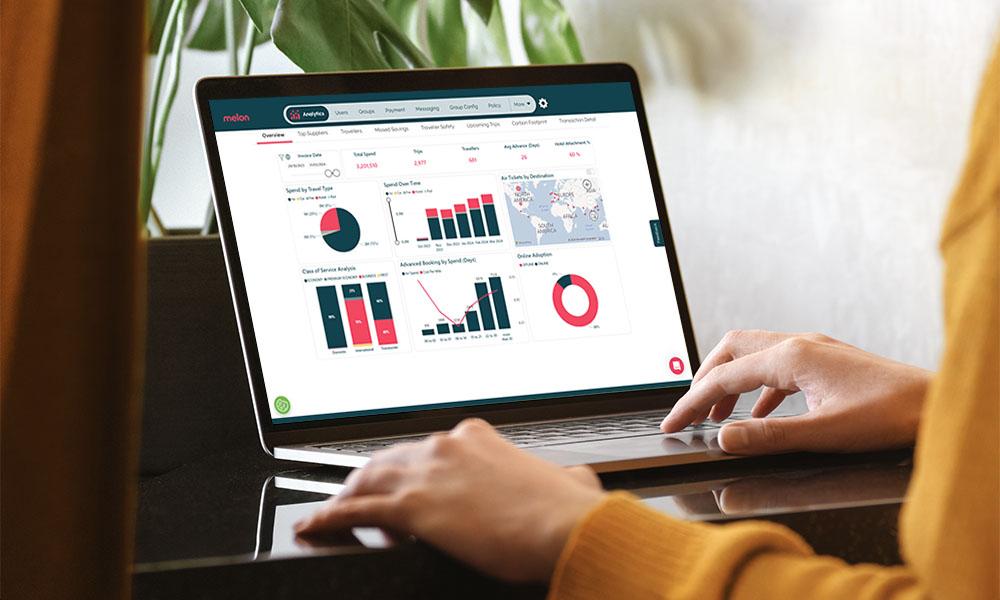
Real-time travel expense tracking: Capture spend as travelers go
Published: Sep 3rd, 2026
Key takeaways:
- Real-time travel expense tracking captures business trip spend the moment it happens instead of weeks later on a manual report.
- Flights and hotels booked through a managed travel program sync automatically, on-trip costs go on corporate cards, and travelers snap receipts from their phones.
- The payoff is that most travel costs never touch a personal card, coding errors drop, policy checks happen at the point of purchase, and finance watches a live number instead of guessing at a stale one.
One trip. A flight booked six weeks out, a hotel charged on arrival, four taxis, two client dinners, a baggage fee, and a crumpled parking stub living in a jacket pocket. By the time all of it reaches finance, the trip is a memory, the quarter's budget has already taken the hit, and someone on your team has been floating company costs on a personal credit card for six months.
Real-time travel expense tracking fixes the timing problem. Rather than waiting on a report, finance sees each cost as it lands, coded and checked against policy, without anyone typing a thing. For CFOs, finance and accounting teams, operations leads, and travel managers at growing companies, that means less company money sitting on personal cards, tighter costs, and real visibility into your travel spend while your people are still standing in an airport.
This article covers what real-time travel expense tracking is, what counts as a travel expense, how to roll it out, what to demand from expense recording tools, and how Corporate Traveler and Ramp handle the whole thing end to end.
What is real-time travel expense tracking?
Real-time travel expense tracking is the practice of capturing business travel spend the moment it happens, from flights and hotels to meals and ground transport, instead of on a manual report weeks later. It combines managed booking, corporate cards, and mobile receipt capture to give finance live visibility into every trip as it unfolds.
Traditional travel expense management happens entirely in the past tense. An employee books a flight, takes the trip, hoards receipts, and eventually keys everything into a report for approval. Finance sees the spend only after it has cleared, which is a bit like checking the weather forecast after a picnic.

Real-time tracking catches each cost at its source. The biggest-ticket items, flights and hotels, log the instant they're booked through a managed travel program, which means the two largest numbers on the trip are captured before the traveler reaches the gate. On-the-road spend such as taxis, meals, parking, and Wi-Fi is captured live: the traveler photographs a receipt, or the system collects it by SMS or email, the tool matches it to the card charge, applies the right category, and checks it against travel policy.
Travel spend is fast, scattered across dozens of small vendors, and close to impossible to control once it's already happened. That's why this shift matters more here than for almost any other expense category. It turns travel expense management from a monthly cleanup job into a continuous, automated flow.
What counts as a travel expense?
Business travel spend spans several categories, and each one is best captured a different way.
| Travel expense category | Examples | Best capture method |
| Airfare | Flights, seat selection, change fees | Booked via travel program, auto-synced |
| Lodging | Hotels, extended stays | Booked via travel program, auto-synced |
| Ground transportation (booked) | Rental cars, rail | Booked via travel program, auto-synced |
| Ground transportation (on-trip) | Rideshare, taxis, parking, tolls | Corporate card plus mobile capture |
| Meals and per diem | Client meals, daily allowances | Corporate card or per diem rules |
| Incidentals | Baggage, Wi-Fi, tips | Mobile receipt capture |
| Mileage | Personal vehicle used for business | In-app mileage log |
Real-time vs. traditional travel expense reports
| Dimension | Traditional travel expense reports | Real-time travel expense tracking |
| Timing | Weeks after the trip | As the trip happens |
| Big-ticket capture | Re-keyed from memory and receipts | Logged at booking |
| Data entry | Typed in by traveler | Automated card and receipt capture |
| Visibility | Monthly, after the fact | Live dashboards, mid-trip |
| Policy checks | Post-submission review | Instant, at point of spend |
| Processing cost | About $58 and 20 minutes per report (GBTA Foundation, the long-standing industry benchmark) | Automated capture, minimal manual handling |
| Reimbursement | Slow, travelers front cash | Fast, cards remove most out-of-pocket spend |
An all-in-one travel platform is what moves a program from the left column to the right one.
Stay in the loop.
The world of corporate travel is always changing. Sign up for newsletter and never miss a beat.
Why does real-time travel expense tracking matter?
Travel is one of the largest controllable costs a company carries, and manual reports keep it hidden until it's too late to act. Processing a single expense report costs about $58 and 20 minutes. Real-time tracking controls spend while it's happening and gets travelers reimbursed fast.
Business travel is a big line item and it keeps growing. GBTA forecasts global business travel spending will reach a record $1.71 trillion in 2026, with more than 1.84 billion business trips taken worldwide, as spending climbs 7.2% while trip volume rises just 1.3%. Translation: companies are taking roughly the same number of trips and paying meaningfully more for them.

Meanwhile the process for tracking that spend hasn't moved much. The long-standing industry benchmark on this comes from the GBTA Foundation, which found that a single expense report costs $58 and takes 20 minutes to complete, and 19% of reports contain errors or missing information that cost another $52 and 18 minutes each to correct. It remains the most-cited figure in expense management, and no one has published a number that replaces it.
There's a fraud angle, too. The ACFE's Occupational Fraud 2026 report estimates that organizations lose about 5% of annual revenue to occupational fraud each year. Its latest edition analyzed 2,402 cases across 143 countries and found a median loss of $104,000 per case, with asset misappropriation schemes, the category that includes expense reimbursement fraud, appearing in 90% of cases.
And there's a human cost. Corporate cards are common but not universal: GBTA's 2026 survey of 4,700 business travelers found 68% are provided with a corporate credit card and 65% say their company requires or encourages booking through a travel management company or corporate booking tool. Which leaves a sizable chunk of your workforce paying for company travel out of their own pocket and waiting.
The cost case for real-time travel expense tracking
| Metric | Figure | Source |
| Global business travel spend, 2026 forecast | $1.71 trillion | GBTA Business Travel Index 2026 |
| Global business trips, 2026 forecast | $1.84 billion | GBTA BTI 2026 |
| Average spend per business trip, global | About $1,128 | GBTA BTI 2025 |
| Cost to process one expense report | About $58 and 20 minutes | GBTA Foundation, industry benchmark study |
| Reports containing errors | 19%, adding $52 and 18 minutes each | GBTA Foundation, industry benchmark study |
| Median loss per occupational fraud case | $104,000 | ACFE Report to the Nations 2026 |
| Travelers given a corporate card | 68% | GBTA BTI 2026 |
Worth noting for US programs: the $1,128 figure is a global average across 66 markets, and US trip costs typically run higher. Our guide to smarter business travel costs works through the numbers by metric for finance leaders benchmarking their own program.
How can companies track travel expenses in real time?

Companies track travel expenses in real time by booking through a managed travel program, putting trip spend on corporate cards, and connecting both to a spend platform with mobile receipt capture. Big-ticket items sync at booking, on-the-road costs are captured live, and nobody builds a report afterward.
The trick is routing spend onto trackable rails so data flows in on its own, and saving manual reimbursement for the rare stray cost. The seven steps below work best in roughly this order, though most teams find they can run a few of them in parallel.
How to set up real-time travel expense tracking in seven steps
- Book travel through a managed program: Route flights, hotels, and car rentals through a TMC so the largest costs are coded and policy-checked at the point of booking. Making it easy to book business travel is what drives adoption in the first place.
- Issue corporate and virtual cards: Put on-trip spend on company cards with built-in limits. Company cards are what make real-time tracking possible in the first place, because every charge lands in the feed the moment it happens. This removes most out-of-pocket costs and creates a live transaction feed from the road.
- Connect booking, cards, and expense tracking: Choose tools that sync bookings with your spend platform so trips and charges live in one place and nobody types the same data twice.
- Define travel policy and approval rules: Set per-category limits, per diems, and thresholds inside the platform. Real-time checks then flag or block breaches at the moment of purchase, which is when you can still do something about it. Tools that let you manage and approve travel in one place make this straightforward.
- Integrate with your accounting or ERP system: Connect the platform to your general ledger so travel transactions reconcile automatically into audit-ready books.
- Deploy the mobile app and train travelers: Have staff capture on-trip receipts by photo, SMS, or email. Keep it to a few taps and adoption takes care of itself.
- Monitor live dashboards and refine: Watch trip spend in real time, act on exceptions, and adjust limits and per diems as patterns emerge.
What are the benefits of real-time travel expense tracking?
The main benefits are less out-of-pocket spend, lower processing costs, fewer errors, stronger policy compliance, and live visibility into trip spend. Company cards mean most travel costs never need claiming back at all, finance forecasts from real data, and travel managers can control costs while employees are still on the road.

Most finance initiatives make one team's life easier at another team's expense. This one is unusual in that the same change pays off in different currencies depending on where you sit: hours saved for some people, cash flow for others, and control for the ones signing off on the budget. That's also what makes it an easy internal sell, because nobody has to absorb a worse process so someone else gets a better one.
Who benefits from real-time travel expense tracking?
| Benefit | What it means | Who gains most |
| Less out-of-pocket spend | Company cards leave nothing to claim back | Travelers, travel managers |
| Lower processing cost | Less manual handling per report | Finance and AP teams |
| Fewer errors | Auto-matched receipts and coding | Accounting teams |
| Stronger compliance | Breaches caught at the source | Finance, operations |
| Live trip visibility | Control and forecast from real data | C-suite, CFO, travel managers |
Three more benefits sit outside that table and tend to get overlooked:



Live dashboards are where most of this becomes visible day to day, and our savings and reporting tools are built around exactly that view.
What features should you look for in travel expense recording tools?
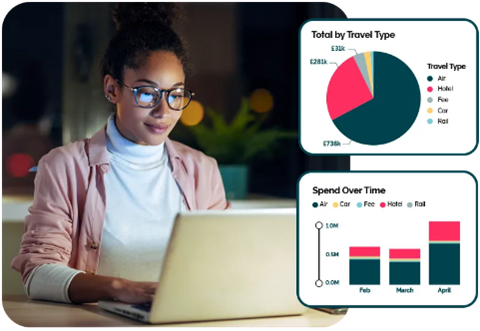
The best travel expense recording tools combine managed booking sync, corporate and virtual cards, automated receipt capture, real-time policy controls, and mobile access. Look for per diem and mileage support, multi-currency handling, and live dashboards so every flight, hotel, meal, and taxi flows in without manual entry.
Plenty of expense recording tools call themselves real-time and still expect a human to build a report at the end of the month. The make-or-break question is whether the tool can pull in booking data on its own. After that, watch how gracefully it handles the messier realities of travel: three currencies in five days, per diems, mileage, and a receipt with faded ink.
Feature checklist:
| Feature | Why it matters for travel | Priority |
| Managed booking sync | Logs flights and hotels at booking, before the trip | Must-have |
| Corporate and virtual cards | Eliminates most out-of-pocket travel spend | Must-have |
| Automated receipt capture by photo, SMS, or email | Captures on-the-road costs with no manual entry | Must-have |
| Real-time policy controls | Blocks or flags breaches at the source | Must-have |
| Per diem and mileage support | Builds your per diem in as a spending limit and calculates mileage at your set rate | Must-have |
| Multi-currency handling | Codes international trips accurately | Must-have |
| Mobile app | Lets travelers expense from anywhere | Must-have |
| Live dashboards and reporting | Continuous visibility into trip spend | Must-have |
| Accounting and ERP integration | Auto-codes and reconciles to the GL | Must-have |
| Cash back or rebates | Recovers a share of travel spend | Nice-to-have |
That integration row is the one buyers skip and later regret, because a platform that won't talk to your accounting stack recreates the manual work you were trying to delete. Corporate Traveler's integrations connect booking, spend, and accounting in a single chain.
How does mobile expense tracking work for employees on the road?
Mobile expense tracking lets employees capture spend from the road: photograph a receipt, tag it to a card charge, and submit in seconds. Flights and hotels booked through the travel program are already logged, so travelers only handle small on-trip costs and finance sees coded data instantly.
Mobile is what makes real-time tracking work for people who are, by definition, nowhere near their desks. Instead of collecting receipts like trading cards, travelers deal with each cost as it happens. So, logging a taxi fare or a coffee takes less time than an elevator ride.
The traveler mobile flow:
-
1. Big-ticket spend is already logged
Flights, hotels, and car rentals appear as tracked spend before the trip begins.
-
2. Spend on a company card
On-trip charges show up in the app in real time, before any receipt is added.
-
3. Capture the receipt
Snap a photo or forward it by SMS or email, and the app matches it to the charge.
-
4. Confirm the details
The app pre-fills category and amount. The traveler taps to confirm or adjust, even across currencies.
-
5. Submit and move on
Company card charges close themselves out once the receipt is matched. Anything paid personally routes to the right approver in-app and gets paid back quickly.
For finance, every one of those steps produces clean, coded, receipt-matched data with nobody chasing anybody. Some apps simply digitize the old month-end process. The ones worth buying remove it. Being able to manage trips on the go is what makes the difference stick.
How do you track out-of-pocket travel costs?
To track out-of-pocket travel costs, travelers should log each personal-card expense immediately in a mobile app, attach a photo receipt, and select the right category. Real-time tools timestamp it and match it to the trip so finance can reimburse quickly instead of leaving employees waiting weeks.
Even with corporate cards and managed booking, some spend still lands on a personal card. A cab with a broken card reader. A quick lunch. A last-minute booking made at 11 p.m. These are the costs where the old process hurts travelers most, because they pay first and hope for the best.
With the global average spend per business trip at about $1,128 and US trips typically running higher, a frequent traveler can have thousands of dollars of company money tied up on a personal card at any given moment. The fix is to capture out-of-pocket spend the second it happens and route it through fast in-app approval.
Steps to track out-of-pocket travel costs:

-
1. Capture the receipt immediately
Photograph or forward it before it disappears into a laptop bag.
-
2. Categorize the expense correctly
Pick the right category so coding stays clean and policy checks apply.
-
3. Match it to the trip
Tag it to the relevant trip so finance sees it in full travel context.
-
4. Submit for approval in-app
Route it against live policy rules so approvers see it now, not in three weeks.
-
5. Track reimbursement status
Follow it from submitted to paid so travelers know exactly when the money lands.
Set a submission deadline and stick to it
Real-time capture only works if people file in real time, so put a deadline in the travel policy rather than hoping for the best. Most programs ask employees to submit out-of-pocket claims monthly, with a hard cutoff at 90 days from the date of the expense. The monthly rhythm keeps claims small and close to the trip they belong to. The 90-day cap gives finance a clean line to close the books against, and it stops a stray February taxi receipt from turning up in July.
Say both numbers out loud in your policy, in your onboarding, and in the app itself. A deadline nobody knows about is not a deadline.
The best long-term fix is to shrink out-of-pocket spend to almost nothing. Book the big items through the travel program, put on-trip costs on corporate cards, and leave only the odd stray receipt to reimburse manually.
How does Corporate Traveler enable real-time expense tracking with partners like Ramp and Emburse?
Corporate Traveler connects booking and spend in one chain. Trips booked with Corporate Traveler sync automatically into your expense platform, whether that's Ramp, Emburse, or another provider, so flights and hotels are logged and coded at booking, receipts are collected automatically, and every charge appears live. No report at the end.
Real-time tracking works best when booking and spend sit in one connected system. As a travel management company, Corporate Traveler books and manages the trip through our platform, Melon, backed by dedicated travel experts and 24/7 support. That covers the biggest costs on any trip. What happens to those costs next depends on which expense partner you run, and we integrate with two of the best.
Corporate Traveler and Ramp
Ramp adds the spend layer: corporate cards, automated expense tracking, and live visibility into every charge. Because all bookings with Corporate Traveler automatically sync with Ramp, a flight booked this morning shows up as coded, trackable spend this morning.
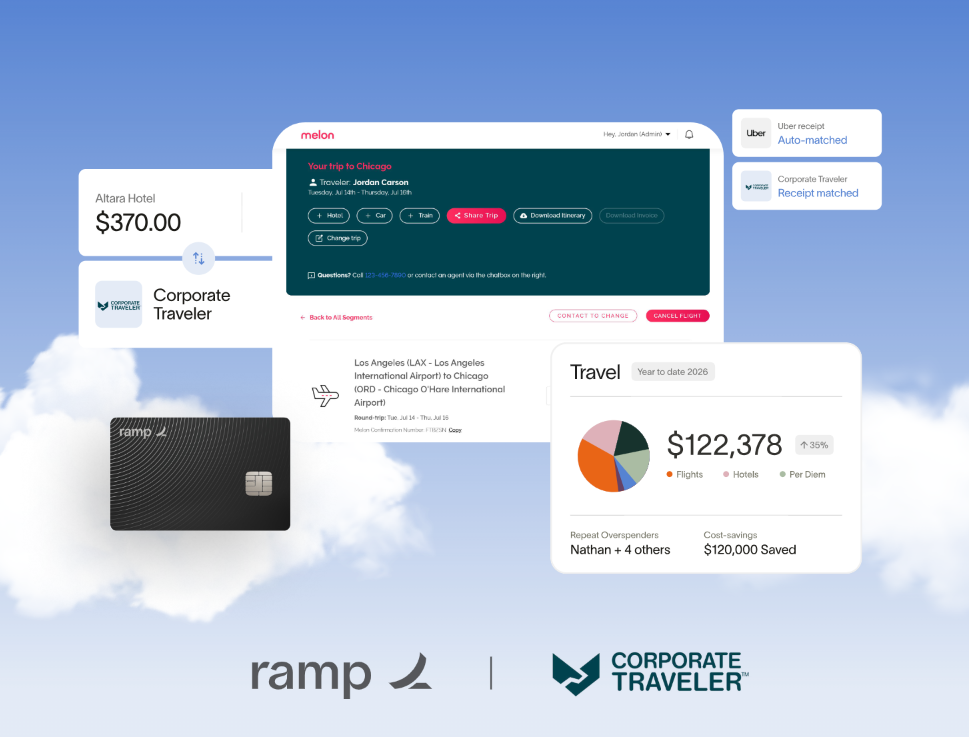
- All-in-one travel and expense: Booking, cards, and expense tracking in one connected flow.
- Big-ticket spend captured at booking: Flights and hotels logged before the trip starts.
- Receipts made easy: Automatically requested, collected, and matched by SMS and email.
- Real-time control: Real-time visibility into every charge made.
- Free to start: Ramp can be deployed in as little as 15 minutes, and 98% of finance leaders agree.
- Proven savings: Save an average of 5%, plus 1.5% cash back on every purchase.
Corporate Traveler and Emburse
Corporate Traveler also partners with Emburse to make the handoff from booking to expense report seamless. Book your travel through Corporate Traveler and your receipts sync straight into Emburse. No manual uploads, no duplicate entries, and nothing left to untangle at month-end.
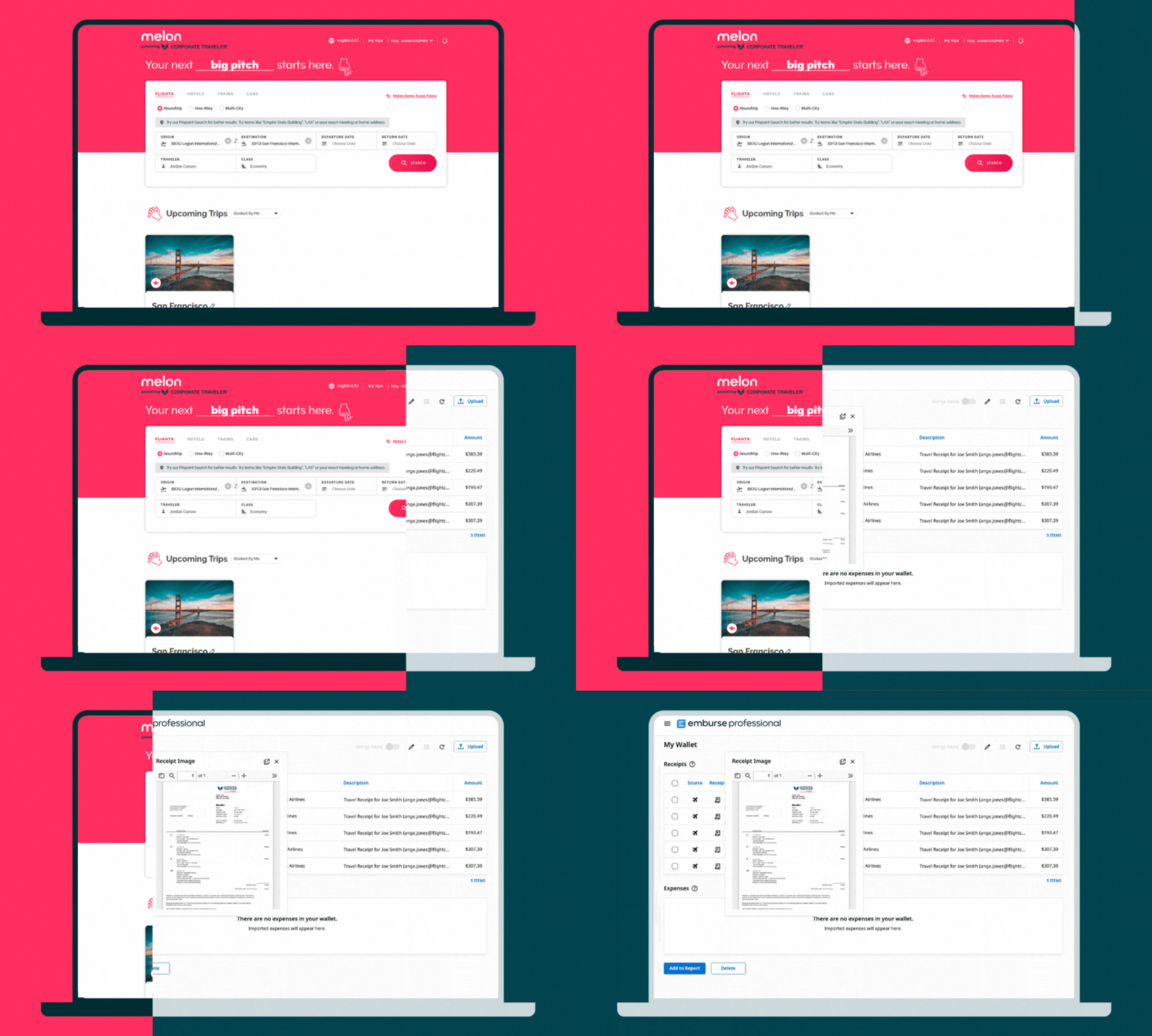
This is how it works:
- Book through Corporate Traveler using your preferred credit card.
- Receipts captured. Air, prepaid hotel and car, and rail receipts sync automatically.
- Expenses prefilled. Amounts and vendor details arrive already filled in.
- Reports submitted. Approval workflows and accounting exports handle the rest.
The part software can't do
Automation is excellent at matching receipts and terrible at rebooking a stranded traveler out of Denver during a snowstorm. Most travel and expense platforms hand you a login and wish you luck. Corporate Traveler comes with the expense integrations and a real travel team, which is the difference our business travel services are built around.
Stop reconciling the past. Start managing the present.
Your travel spend is happening right now. You may as well be able to see it. Talk to an expert and we'll show you what real-time travel expense tracking looks like on your program, with your numbers.

FAQs
-
Is travel expense tracking the same as expense management software?
Not quite. Expense management software is the broad category. Travel expense tracking is the travel-specific slice: flights, hotels, ground transport, meals, and incidentals. Real-time travel tracking captures that spend as it happens through managed booking, cards, and mobile capture, rather than on a report built weeks after the trip.
-
How much can real-time travel expense tracking save a company?
Savings come from three places: lower processing costs, fewer errors, and less leakage. The GBTA Foundation's benchmark study, still the standard reference in the category, puts the cost of processing one manual expense report at about $58, with 19% of reports needing rework. Multiply that by your annual report volume and the automation case tends to make itself.
-
Does real-time travel expense tracking work for small businesses and startups?
Yes, and growing companies often see the biggest lift, because they feel every hour of finance time and every delayed reimbursement. Cloud tools deploy fast with no heavy IT project. Managed booking, corporate cards, and mobile capture give small teams live visibility into trip spend without hiring anyone new.
-
How does real-time tracking reduce travel expense fraud?
By making spend visible while it's happening. The ACFE's 2026 Report to the Nations found asset misappropriation schemes, which include expense reimbursement fraud, in 90% of the 2,402 cases it analyzed, with a median loss of $104,000 per case. Real-time policy checks, automatic receipt matching, and live dashboards flag duplicate, inflated, or out-of-policy claims before anyone pays them.
-
What's the difference between corporate cards and out-of-pocket reimbursement for travel?
With corporate cards, travelers spend company money directly, so charges are tracked in real time and there's nothing to reimburse. Out-of-pocket means the traveler pays first and claims later, tying up personal cash against a global average trip cost of around $1,128. Real-time platforms lean hard on cards and reserve reimbursement for the rare personal cost.
-
How does a travel management company help with real-time expense tracking?
A TMC handles the booking layer, which is where the largest travel costs originate and where they're easiest to code and policy-check. When those bookings sync straight into a spend platform, the bulk of the trip is tracked without anyone lifting a finger, leaving only small on-trip costs to capture by phone.
Related resources


