

How SMEs can drive business travel savings without slowing growth
Your travel budget has a leak. Several, actually. Last-minute bookings, untracked spend, employees going rogue on Google Flights, and unused ticket credits gathering dust all add up fast. The good news? Business travel is one of the most controllable costs in your business. This article shows you how, including the part most travel companies won't tell you (but we will): a great dedicated Travel Manager beats a great algorithm every time.
SMEs can unlock business travel savings by improving booking visibility, enforcing travel policies, consolidating suppliers, and using smarter travel technology. A centralized, managed travel program helps businesses control spend, reduce admin headaches, support travelers faster, and uncover savings opportunities across flights, hotels, and reporting.
Picture this: your sales lead books a last-minute flight on her personal card, your ops manager approves a hotel that's twice the rate cap, and your finance team finds out about all of it six weeks later while chasing receipts before month end. Sound familiar?
For most SMEs, this isn't a horror story. It's a Tuesday. According to GBTA's 2025 Business Travel Index, global business travel spending is projected to reach a new historical high of $1.57 trillion in 2025, and more than half of SMEs said their 2025 spend was higher than 2024. Most of that growth is happening without the structure to manage it.
A structured travel program changes that, and SME travel solutions have come a long way. With centralized booking, negotiated supplier rates, automated reporting, and a dedicated Travel Manager who knows your business, you get real control over travel spend without creating more work for finance or operations.
How can companies save on business travel costs?
Companies save money on business travel expenses by centralizing bookings, enforcing travel policies, using negotiated rates, improving approvals, and actually analyzing spend. Businesses that combine smart technology with dedicated travel management support typically see the biggest, fastest results.
Here are seven things that help:
- Create a clear travel policy: Set the rules and make them stick. A solid policy covers booking windows, rate caps, preferred suppliers, approval chains, and expense reimbursement. Without one, every traveler is running their own personal travel agency on the company dime.
- Centralize all travel bookings: One platform. One source of truth. When bookings are scattered across personal credit cards and consumer booking sites, your finance team is basically doing detective work every month.
- Book flights and hotels earlier: Advance booking can reduce travel costs by 17% on average compared to last-minute purchases. Aim for two to three weeks ahead for domestic trips, and a month-plus for international. Your budget will thank you.
- Use negotiated supplier rates: Preferred hotel and airline programs unlock pricing that's genuinely hard for SMEs to access independently. Working through a TMC (travel management company) changes that.
- Monitor travel spending monthly: You cannot manage what you cannot see. Regular reporting catches overspending early, surfaces patterns, and makes future budget conversations a lot less awkward.
- Automate approvals and reporting: Manual approval chains are slow, error-prone, and completely unnecessary. Automated workflows keep things moving while keeping spend in check.
- Get proper traveler support in place: A missed connection or a cancelled flight is expensive on top of being stressful. Having dedicated support means problems get solved before they turn into $800 same-day rebooking disasters.
| Strategy | Business impact | Savings potential |
|---|---|---|
| Advance booking | Lower airfare and hotel rates | High |
| Preferred hotels | Consistent, predictable pricing | Medium |
| Approval workflows | Reduced overspending | Medium |
| Reporting dashboards | Better forecasting and control | High |
| Dedicated travel support | Fewer costly disruptions | High |
What are the biggest corporate travel expenses?
The largest corporate travel expenses are airfare, hotels, ground transportation, meals, and admin costs. Unmanaged bookings, last-minute changes, and limited spending visibility can turn a reasonable travel budget into a very uncomfortable quarterly conversation.
Air and hotel account for 70% of the average corporate travel budget, and they're also where costs spiral fastest when bookings are unmanaged. According to Corporate Traveler's own data from 17,000+ managed travel programs, booking 21 or more days in advance saves 17% per ticket on average. And that's before factoring in negotiated hotel rates and preferred supplier programs.
Add volatile airfare markets into the mix (fares swung up 7.9% in 2024 and dropped 3.4% in 2025, per the U.S. Bureau of Labor Statistics) and the case for a structured travel program becomes hard to argue with. You can't predict the market, but you can protect your budget from it.
| Expense category | Typical cost driver | Cost-control opportunity |
|---|---|---|
| Airfare | Last-minute fares and flexible ticket premiums | Advance booking and preferred airline programs |
| Hotels | Peak pricing and no preferred rates | Negotiated hotel programs and rate caps |
| Ground transportation | Ride-share variability with no vendor agreements | Vendor agreements and clear per diem guidelines |
| Meals | Inconsistent policy, no per diem | Per diem guidelines baked into your travel policy |
| Admin work | Manual approvals and reimbursement processes | Automation and expense platform integrations |
Quick audit checklist to reduce business travel costs:
- Identify your most frequent travel routes
- Audit booking leakage (bookings made outside your approved channel)
- Review unused ticket credits and expiring balances
- Consolidate suppliers where possible
- Check how many employees are booking on personal cards
What causes corporate travel overspending?
Corporate travel overspending and budget leaks comes down to unmanaged bookings, inconsistent policies, last-minute changes, no reporting, and fragmented suppliers. If any of these sound familiar, your budget is already taking hits you're not tracking.
Red flags to check right now:
- Bookings made outside approved channels (booking leakage)
- Last-minute airfare purchases at full unrestricted fare
- Multiple overlapping suppliers with no preferred rates locked in
- Unused ticket credits and expiring balances nobody's tracking
- Manual reimbursement processes that drag on for weeks
| Overspending cause | Business impact |
|---|---|
| Booking leakage | Higher travel costs with zero visibility |
| Manual approvals | Slow decisions and unwelcome budget surprises |
| Poor reporting | Spending patterns you can't see, can't fix |
| No preferred suppliers | Inconsistent pricing that's almost always too high |
How does a corporate travel policy reduce costs?
A corporate travel policy is one of the most effective drivers of corporate travel savings, reducing costs by setting clear booking rules, approval processes, spending limits, and preferred suppliers. Without one, you're basically funding a free-for-all and calling it a travel program.
A good travel policy isn't bureaucracy for its own sake. It's the thing that turns "our people book whatever they want and we find out at month end" into an actual managed spend category. Here's what it needs to cover:
- Booking windows: How far ahead trips need to be booked
- Hotel and air rate caps: Maximum nightly hotel rates ideally tiered by city, and maximum airfare thresholds by trip length or route
- Approval workflows: Who signs off on what, and how fast
- Preferred vendors: Your negotiated airlines, hotels, and car rental companies
- Expense reimbursement rules: What's covered, what's not, and exactly how to claim it
- Emergency support procedures: Who travelers call when something goes wrong
| Policy area | Benefit |
|---|---|
| Advance booking rules | Lower airfare costs |
| Preferred suppliers | Consistent, negotiated pricing |
| Approval workflows | Budget control and accountability |
| Expense guidelines | Reduced overspending and faster reimbursement |
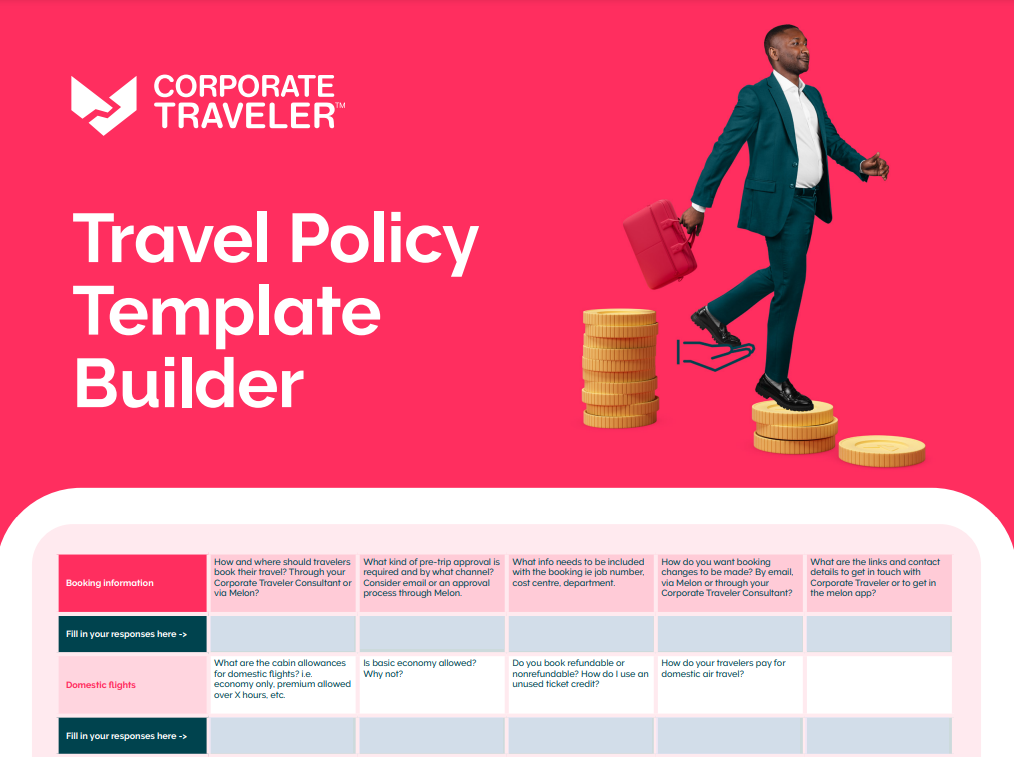
Don't start from scratch.
Grab our travel policy template and build your program in a fraction of the time.
How does technology help reduce corporate travel costs?
Travel technology delivers real corporate travel savings by centralizing bookings, automating approvals, improving policy compliance, and providing detailed reporting. The best travel platforms make trip management simple, spending visible, and savings opportunities hard to miss.
| Technology feature | Operational benefit |
|---|---|
| Centralized booking | Full visibility into spend by traveler, team, or route |
| Automated approvals | Faster processing, far fewer manual steps |
| Expense platform integrations | Reduced reconciliation work for your finance team |
| Reporting dashboards | Budget forecasting |
| Live traveler support | Fewer disruptions, less costly emergency rebooking |
Our Melon platform delivers all of this but with something most travel tech can't offer: real humans behind the screen. Melon gives you the data, visibility, and automation you'd expect from a modern travel platform. Your dedicated Travel Manager uses that same data to find savings, flag risks, and proactively optimize your program over time. Melon also works with your existing expense platforms via integrations, rather than replacing them, and that's where the real corporate travel cost savings start to show up.
Things your travel tech stack should be doing for you:
- Mobile booking so travelers aren't pinned to a desktop
- Itinerary updates and alerts when plans change
- Spend analytics by team, route, or cost center
- Traveler tracking for duty of care
- Policy alerts that catch out-of-policy bookings before they're confirmed
How can finance teams track business travel ROI?
Finance teams track business travel ROI by monitoring spend, policy compliance, supplier usage, booking trends, and traveler productivity. Comprehensive reporting makes the difference between reacting to problems and actually getting ahead of them.
The ROI conversation isn't just about what travel costs. It's about whether it's delivering. Businesses that treat corporate travel cost savings as a measurable outcome — not just a happy side effect — are the ones that can actually demonstrate the value of their travel program to leadership. That means tracking both sides: the money going out, and the value coming back.
| KPI | Why it matters |
|---|---|
| Average trip cost | Your baseline for budget control and benchmarking |
| Advance booking rate | The clearest leading indicator of cost efficiency |
| Policy compliance rate | If this is low, overspending is high |
| Supplier utilization | Shows whether negotiated rates are really being captured |
| Cost per traveler | The number you need for meaningful forecasting |
With solid reporting in place, finance leaders stop reacting to travel spend and start managing it, catching trends early, making the case for smarter investment when the ROI is genuinely there, and finally having the data to back up budget conversations.
Why a dedicated Travel Manager is your secret savings weapon
Dedicated Travel Managers find savings that no platform can match. With deep knowledge of your business, your travelers, and the market, they catch what algorithms miss and fix what goes wrong before you even know about it.
Yes, technology is great, but it doesn't know that your Director of Sales refuses middle seats, that you run Chicago to New York every Tuesday, or that there's a routing via Philadelphia that saves $200 and shaves 40 minutes off the journey. It doesn't know any of that, because it doesn't know you.
That's exactly what a dedicated Travel Manager brings and it's the reason our clients consistently find savings that go well beyond what self-service tools deliver.
Here's what your dedicated Travel Manager is really doing for your bottom line:
- Creative ticketing: Finding fare combinations, split ticketing options, and routing alternatives the standard booking flow walks right past.
- Route risk assessment: Steering travelers away from connections that are one weather event away from a missed meeting and an expensive hotel night.
- Hotel guidance: Recommending genuinely good-value hotels for each destination based on your policy, your preferences, and years of real-world market knowledge.
- Disruption resolution: When things go sideways (flight canceled, hotel overbooked, itinerary in flames), your Travel Manager is already solving it before your traveler has even landed.
- Ongoing program optimization: Reviewing booking patterns, supplier usage, and spend data regularly to surface savings you never would have thought to look for.
At Corporate Traveler, that same dedicated Travel Manager is with you for the long haul. Not a rotating call center. Not a chatbot. A person who becomes a genuine extension of your team. And the corporate travel savings they unlock tend to compound the longer they work with you.
Stop guessing. Start saving with Corporate Traveler
Your travel budget is one of the most controllable cost lines in your business, but only if you have the right program in place. Corporate Traveler works with SMEs and fast-growing companies to build travel programs that reduce costs, support business travelers, and give finance teams the visibility they need. Plus, as your company grows, your travel program can easily grow alongside it.
Book a meeting today to talk about where you're spending and where you could be saving.
FAQs
-
What is a reasonable corporate travel budget?
A reasonable corporate travel budget depends on company size, travel frequency, industry, and growth stage. Businesses should build budgets around travel goals, historical spending, policy compliance, and projected trip volume, while leaving flexibility for seasonal pricing changes and operational needs. A dedicated Travel Manager can help you benchmark your current spend against industry norms and identify where adjustments make sense.
-
How far in advance should companies book business travel?
Most companies reduce airfare and hotel costs by booking business travel at least two to four weeks in advance for domestic trips. Earlier booking windows typically improve pricing, supplier availability, and policy compliance, while reducing last-minute travel disruptions. Corporate Traveler's own client data shows that extending booking lead times by just one to two weeks can generate meaningful savings year over year.
-
Can small businesses negotiate travel rates?
Yes. Small businesses can often access negotiated travel rates through TMCs, preferred supplier programs, or consolidated booking volume. Negotiated rates may include hotel discounts, airline savings, flexible fare terms, and added traveler benefits that are difficult to secure independently.
-
What is booking leakage in corporate travel?
Booking leakage happens when employees book travel outside approved systems or policies. Leakage reduces visibility, weakens supplier negotiations, increases reporting gaps, and often leads to higher overall travel costs. A centralized booking platform with clear policy enforcement is the most effective way to close the gap.
-
What departments benefit most from travel cost visibility?
Finance, operations, HR, procurement, and executive leadership teams all benefit from travel cost visibility. Comprehensive reporting helps businesses improve forecasting, monitor compliance, support travelers, and identify cost-saving opportunities across departments and regions.
-
Does travel management software help reduce costs?
Yes. Travel management software helps businesses reduce costs through centralized booking, automated approvals, policy controls, reporting dashboards, and negotiated supplier access. These tools also reduce manual work and improve traveler experience. The biggest gains, however, come when that technology is backed by a dedicated Travel Manager who can actively optimize your program instead of just surfacing the data.
Related resources


